The second section of Nil Sorsky's monastic Ustav presents advice on how to counteract the temptations that proceed from the eight principle passions. In the first subsection of this second section, the specific passion of gluttony is dealt with, in its usual place, according to the tradition passed down from the Fathers of the Church. It is worth noting the organization of the list. The passions are listed in two groups of three, followed by one group of two. The first group comprises passions, which affect the body. The second group contains passions that affect the soul, and the third group enumerates the two remaining passions, which affect the spirit. Gluttony, fornication and covetousness are the bodily passions. The soul's passions are anger, sadness and acedia. The spirit's passions are vainglory and pride.
Gluttony is first in the list and, in the monastic tradition bears a special importance, because the abuse of food is seen to be the root of all the other vices. As a proof of this contention, the tradition points out that it was through the abuse of food that the first man and woman fell into sin and lost Paradise. Developing this line of thought further, Nil notes at the end of the section on gluttony that "How many, not controlling their appetite, fall into a ditch of the vice of impurity and sordidness not describable in words." Thus, he connects the discussion of the vice of gluttony with the next section on fornication.
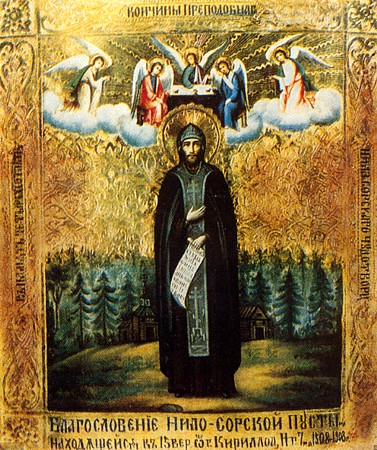
The specific advice of Nil on the vice of gluttony is both concise and simple. In general, he advises his reader to eat only once per day and for the measure of food to be determined over time through a process of experimentation. He writes:
"If a monk seems to feel an excessive fullness after a meal, let him decrease the amount during the next meal. But when he sees that the amount of food he had taken was inadequate to sustain his bodily energy, let him then increase the amount a bit more. And in this way after he has learned what is necessary through experience, he should settle upon such a quantity of food that can support his bodily strength. Thus he will not be a slave to the pleasure of the palate, but be guided by what is truly necessary."
Just as the quantity of food is to be determined through an experimental process, so too are specific foods to be taken or avoided according to the individual's constitution. Nil readily admits that the young and the strong may be able to eat almost anything, but that the old and the weak very well may require specific foods in specific quantities.
Although Nil says in two places that the monk is to refuse nothing, it is clear that an exception exists for foods, which the individual monk knows to be harmful to his body. In our modern terms, we would likely put food allergies in this category, and Nil would most likely put strong aversions into the same grouping. The references to "refusing nothing" spring from the practice of Nil's monastery to receive gifts from laity in the form of food. As mentioned above, Nil exhorts his monks to receive every kind of food, which is offered, stressing in one place that every kind of food (even desserts) have a purpose in the building up of the body if used in their proper measure and moderation.
"There are various bodies with differing strengths" Nil admits. So, on this basis, there has to be a further explication of what was laid out above, namely the instruction to determine the measure of food experimentally. That needed explication comes a paragraph later, when the saint writes:
"In general, a novice can be guided by the best rule, namely to stop eating food when he feels still a bit hungry. But if he feels full, he does not sin in this. But having allowed himself to eat to satiety, let him reproach himself. In this manner he will transform the attack of his enemy and put himself on the path to victory over his enemy."
Nil goes on to discuss the appropriate time during the course of the day to take food. Basically, in accord with the entire monastic tradition, Nil insists that the proper time during the day is the ninth hour (about 3 PM at the vernal and autumnal equinox, but about three hours before sunset during the rest of the year– keeping in mind that anciently the hours themselves in the winter were shorter and those in the summer were longer). On fast days, the monk is simply to wait longer to eat, taking his meal after his prayer at sunset (Vespers).
What Nil outlines in the subsection on gluttony amounts to a comprehensive and holistic weight management program. First, the individual who embarks upon it needs to experientially determine the proper measure of food by deliberately ending his meal when he is still hungry. If his strength is maintained by the amount of food that was taken at the meal, then he only needs to consistently eat the same amount of food (again being careful to halt the meal at a point before satiety). If, however, he feels weak before his next meal, he knows that he must increase the amount of food by a reasonable increment. Second, the individual practicing the program is to adhere to what we would today call "intermittent fasting," taking his meal only once a day in the late afternoon (although Nil allows the addition of a "collation" in the evening if it is necessary for strength).
Ultimately, the discipline requires an individual to reorient himself toward the sensation of hunger. This is the case, because hunger can longer be the determining factor for whether the individual eats. Nil is quite explicit. The determining factor for whether food is taken and in what measure is strength. Hunger, on the contrary, is to be regarded as a sure sign that food is being taken in the appropriate amount. If hunger remains, then the individual has not overeaten. Only his level of strength the following day can determine whether he has undereaten.
The discipline described in the Ustav requires a heightened awareness of the body and its responses to food or the lack thereof. In order to stop eating at the appropriate time (that is, when some measure of hunger is still preserved) it is doubtful that one could eat while otherwise preoccupied by something that would engulf self-awareness (watching engrossing video, etc.). On the contrary, the ideal would be similar to what is sometimes referred to as "mindful eating," in which the person eating is solely intent on the sensations of eating. However, the monastic tradition of table reading also preserves self-awareness.

No comments:
Post a Comment