In the enormous number of hagiographies that come down to us from Christian Tradition, who are the people who are the most devoted to the Mother of God? Invariably, the great devotees of Mary, Most Holy, are those who were very great sinners, converted to the Lord through the loving kindness of their good Mother. Earlier in the spring, I brought to you the example of the long alphabetic hymn written in Ge'ez (the liturgical language of Ethiopia) by an anonymous Ethiopian monk. Nothing is known about the author, except what he himself tells us in the body of the hymn. He tells us that he was among the greatest of sinners, but, through the pity of the Most Holy Mother of God, he was brought to repentance and reconciled with Her Son. This same wandering monk wrote his hymn in homage to the Mother of God as a offering of thanksgiving for her intercession, so instrumental in bringing him repentance and forgiveness.
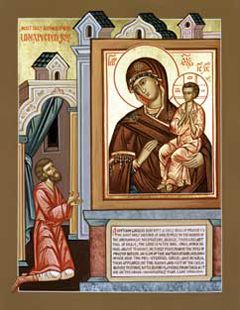
In the same way, we have the miraculous icon called "Unexpected Joy." The icon of the Most Holy Mother of God, in this case is an icon inside an icon. The icon of her holding her Son is depicted hanging on a wall with a youth praying before it. There are three inscriptions on the icon. The first consists of words coming from the youth's mouth addressed to the Mother of God. The second, consists of the words of the Blessed Mother's reply, and the third, underneath Our Lady's icon, is a synopsis of the beginning of the icon's legend.
The icon depicts a moment in a story. The story is that there was a youth who was living a very sinful life. Nevertheless, he had a personal prayer rule of praying the Archangel Gabriel's greeting to the Mother of God 150 times every day. One day, he was fulfilling this rule just before leaving his house to commit sin. Just as he was finishing his prayers, the icon seemed to come alive, the Christ-child held up His little hands and copious amounts of blood poured from His little hands, His feet and His side. The youth cried out, "O Mistress, who has done this?" The Mother of God replied, "You and other sinners re-crucify my Son daily." The young man repented and obtained the forgiveness of his sins. The youth's freedom from sin is the "Unexpected Joy" for which the icon is named.
The message of these two examples seems to be: if you want your sins forgiven, you had better be devoted to the Most Holy Mother of God. In light of the Church's hymnography, this makes perfect sense. The Virgin's intercession on behalf of sinners is not infrequently depicted in the hymns. Although it is often said that the Lord will refuse nothing to His Most Holy Mother, the hymns usually depict this intercession as pretty much a "hard sell." An example of this is the metrical hymn by Saint Theodore the Studite, in which, in each of the nine odes, Theodore entreats the Mother of God, who, in turn, entreats her Son. He replies to her; then, she turns again and addresses Theodore. Finally, at the end of ode nine, Christ finally concedes to His Mother that He will forgive Theodore's sins as long as he continues to show "fruits of repentance.
Naturally, if we want our sins to be forgiven, we need to make our confession and receive absolution, but, it seems, there is more to it than that. If we truly want forgiveness and freedom from sin, we have to become very, very attached to the Most Holy Mother of God, our Mother. Perhaps the essential nature of this devotion in the areas of the remission of sins and freedom from sinful habits should be a regular part of the Legion's kerygma. Perhaps we should be saying to all our neighbors, "Do you want your sins to be forgiven? Then draw near to the Most Holy Mother of God. Love her and become very devoted to her. Ask her to obtain forgiveness for you. Don't leave her alone until she does it."

No comments:
Post a Comment